01 / About the name
What is a deep field?
In 1995, astronomers pointed the Hubble telescope at a patch of sky that looked completely empty — and left it there for ten days. The patch was not empty. It never had been.
Turn up the exposure
This is a real image: the Hubble eXtreme Deep Field. Move the control. Nothing is being added to the picture — you are simply collecting more of the light that was already arriving.

NASA, ESA, G. Illingworth, D. Magee, and P. Oesch (University of California, Santa Cruz), R. Bouwens (Leiden University), and the HUDF09 Team
Patience is the instrument
A deep field is not a processing trick, and not a special corner of the sky. It is a very long exposure of an apparently empty spot. Photons from those galaxies had been travelling for billions of years and were arriving the whole time. The only missing ingredient was somebody willing to wait for them.
That is why the first proposals were unpopular: spending ten days of an extremely expensive telescope photographing "nothing". The result changed what we thought we knew about how many galaxies exist.
- Empty to the eyeThe fields are chosen precisely because there is nothing bright in the way.
- TinyNASA describes the first field as about one-thirteenth the diameter of the full Moon.
- CumulativeLater versions stack years of exposures of the very same spot.
Thirty years of looking deeper
Every advance came from looking longer, not from looking somewhere else.
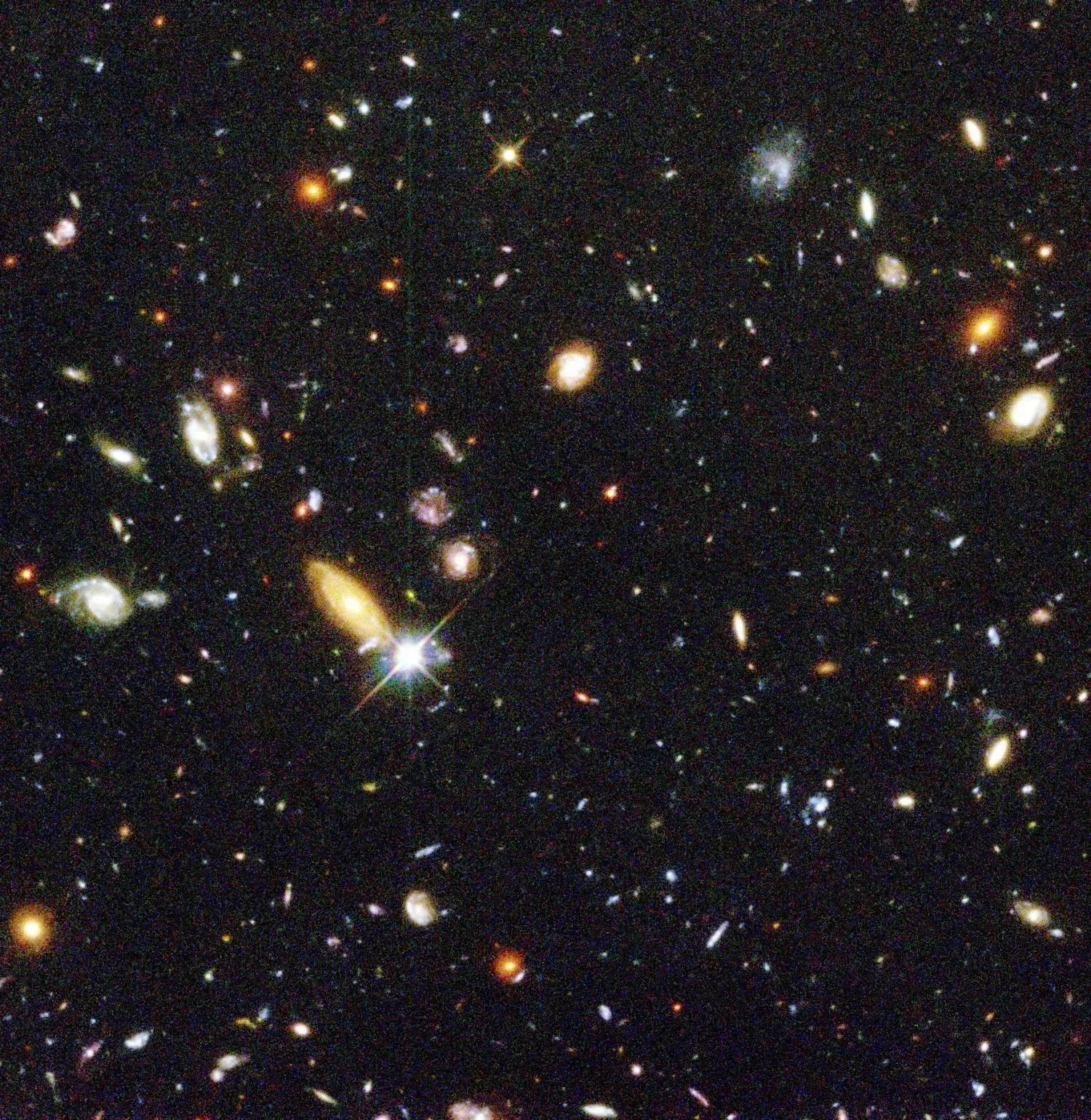
NASA, Robert Williams, and the Hubble Deep Field Team (STScI) 1995
Hubble Deep Field
~3,000galaxies found
Astronomers pointed Hubble at a patch of sky in Ursa Major that looked completely empty, and held it there for ten days straight. Telescope time is precious and the gamble was unpopular. The blank patch came back carrying roughly three thousand galaxies. NASA describes the field as about one-thirteenth the diameter of the full Moon.

NASA, ESA, H. Teplitz and M. Rafelski (IPAC/Caltech); A. Koekemoer (STScI), R. Windhorst (Arizona State University) and Z. Levay (STScI) 2004
Hubble Ultra Deep Field
~10,000galaxies found
A longer stare at a different empty patch, this time in the constellation Fornax. The count roughly tripled. The version shown here is a composite assembled from exposures taken between 2002 and 2012, adding ultraviolet light that Hubble had not previously collected for this field.

NASA, ESA, G. Illingworth, D. Magee, and P. Oesch (University of California, Santa Cruz), R. Bouwens (Leiden University), and the HUDF09 Team 2012
Hubble eXtreme Deep Field
13.2bnyears of lookback time
Ten years of exposures of the same small region, stacked into one frame. NASA counts about 5,500 galaxies in it, some of them seen as they were 13.2 billion years ago. Nothing new was added to the sky. The picture simply got deeper.

NASA, ESA, CSA, STScI 2022
Webb's First Deep Field
A grain of sandof sky, held at arm’s length
The James Webb Space Telescope looked at galaxy cluster SMACS 0723 in infrared. NASA describes the patch it covers as roughly the size of a grain of sand held at arm’s length by someone standing on the ground. The cluster’s own gravity bends and magnifies the light of galaxies far behind it, smearing them into the bright orange arcs you can see curving around the centre.
Look closer: gravity as a lens
In Webb’s first deep field, the mass of the foreground cluster bends light from far more distant galaxies and stretches them into orange arcs. Drag the magnifier around: there are whole galaxies in regions that look like plain black background at first glance.

Tap, drag or use arrow keys to look closer
NASA, ESA, CSA, STScI
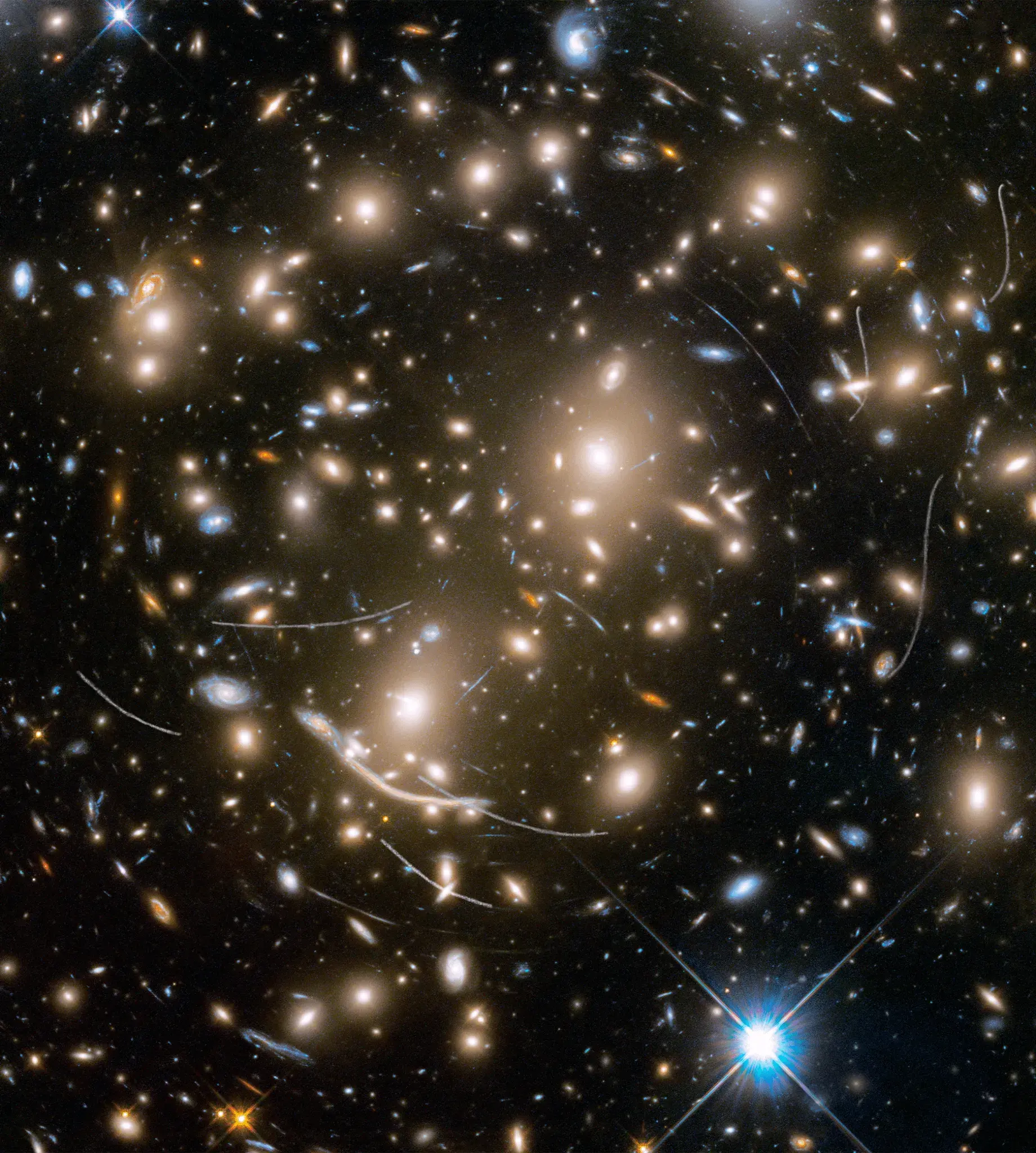
Galaxy cluster Abell 370, roughly 4 billion light-years away, was one of the first places this effect was observed. The thin white curving streaks are far nearer asteroids that crossed the frame during the exposures.
NASA, ESA, and STScI
02 / Why it matters to us
An object rewards long exposure too.
The first look at a piece is a short exposure. You register the brightest things: the size, the colour, the price. Almost everything else falls below the threshold.
Stay longer and the rest starts to arrive. The mark of the tool. The place where the artist changed their mind. The wear on one edge that says somebody used this for forty years. The piece did not change. What changed is how much of it you collected.
That is why this gallery is called Deepfield. The longer you look at something, the more you see — and the more likely you are to care about it.
Image credits and usage
Every image on this page comes from NASA and is reproduced for educational purposes. NASA content is generally not subject to copyright in the United States and may be used for educational or informational purposes with NASA credited as the source.
- Hubble Deep Field — NASA, Robert Williams, and the Hubble Deep Field Team (STScI)
- Hubble Ultra Deep Field — NASA, ESA, H. Teplitz and M. Rafelski (IPAC/Caltech); A. Koekemoer (STScI), R. Windhorst (Arizona State University) and Z. Levay (STScI)
- Hubble eXtreme Deep Field — NASA, ESA, G. Illingworth, D. Magee, and P. Oesch (University of California, Santa Cruz), R. Bouwens (Leiden University), and the HUDF09 Team
- Webb's First Deep Field — NASA, ESA, CSA, STScI
- Abell 370 — NASA, ESA, and STScI
Deepfield Gallery is not affiliated with, sponsored by, or endorsed by NASA. These images appear here purely as educational material and are not used alongside any item offered for sale.